
Making a ten · Ages 7–8
7 + 6: what if we filled the ten first?
Does your child count “7, 8, 9, 10, 11, 12” and get 12 for 7 + 6? It isn’t necessarily a lack of attention: mostly, there’s no simple way to check. This free printable shows how to fill the ten first (7 + 3 = 10, then 3 more), with questions instead of corrections and ten frames to fill.
Download the printable (PDF, 2 pages)US Letter size. Print single-sided, at 100% (actual size). Black and white is fine.
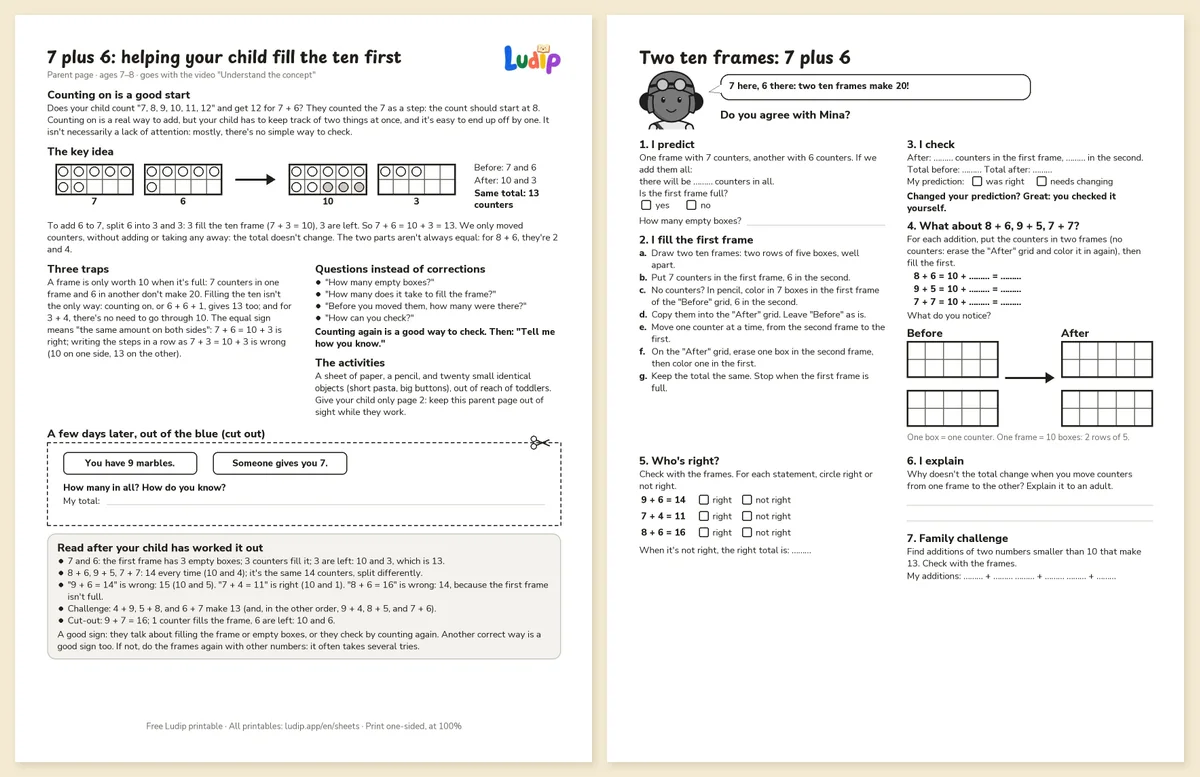
Page 1, for you
- Why counting on makes it easy to end up off by one.
- The key idea, in a simple diagram: fill the ten frame (7 and 6 become 10 and 3; same total, 13 counters).
- Three traps: a frame is only worth 10 when it’s full, other correct ways exist, and what the equal sign means.
- Four questions to ask instead of correcting.
- The activities: a sheet of paper, a pencil and twenty small identical objects (short pasta, big buttons), out of reach of toddlers; give your child only page 2.
- Notes to read after your child has worked it out, and a cut-out slip for a few days later.
Page 2, for your child
- A page with written instructions, which your child fills in.
- Mina says two ten frames make 20: “Do you agree with Mina?”
- Seven steps: predict, fill the first frame, check, try 8 + 6, 9 + 5 and 7 + 7, say who’s right, explain, then a family challenge.
- Two grids, “Before” and “After,” with two ten frames each, to color in when there are no counters at hand.
Our videos for parents
This printable goes with the “Making a ten” episode of “Understand the concept,” our video series for parents. Find our videos on Ludip’s YouTube channel.
Visit Ludip’s YouTube channelLudip: Math & Science Stories
Ludip is a collection of math and science comic series for kids. Every episode tells a story around one concept to understand, then activities invite your child to explore it through play. Ludip is coming to iPhone, iPad and Android.
Get notified at launch