The average · Ages 11–12
Does the average have to be one of the numbers?
Does your child say the average has to be one of the numbers? It isn’t carelessness: they’re figuring out what the word means. This free printable shows the average as what each one would get if we evened everything out, with questions instead of corrections and stacks of books to even out.
Download the printable (PDF, 2 pages)US Letter size. Print single-sided, at 100% (actual size). Black and white is fine.
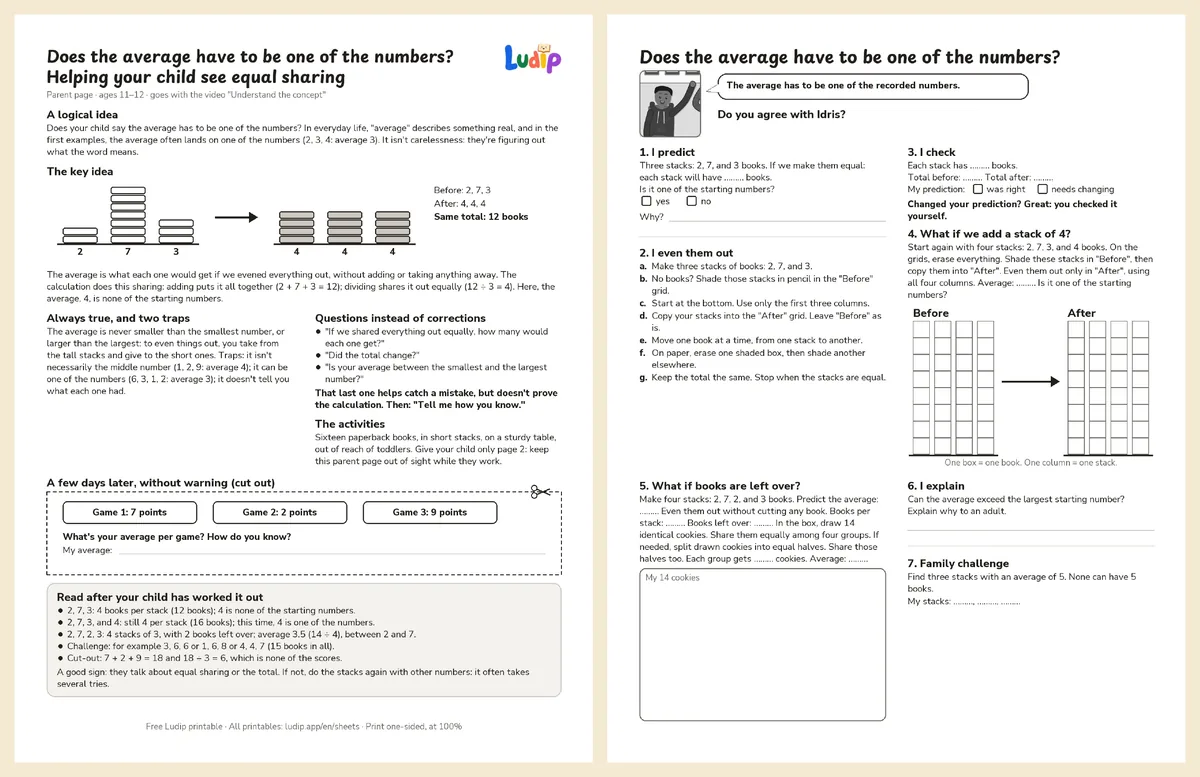
Page 1, for you
- Why “the average has to be one of the numbers” is a logical idea.
- The key idea, in a simple diagram: even out the stacks without adding or taking anything away (2, 7 and 3 become 4, 4 and 4; same total, 12 books).
- What is always true (the average is never smaller than the smallest number or larger than the largest), and two traps.
- Three questions to ask instead of correcting.
- The activities: sixteen paperback books in short stacks, on a sturdy table, out of reach of toddlers; give your child only page 2.
- Notes to read after your child has worked it out, and a cut-out slip for a few days later.
Page 2, for your child
- A page with written instructions, which your child fills in.
- Idris says the average has to be one of the recorded numbers: “Do you agree with Idris?”
- Seven steps: predict, even out, check, add a stack of 4, handle books left over, explain, then a family challenge.
- Two grids, “Before” and “After,” to shade the stacks when there are no books at hand.
- A box to draw and share 14 cookies.
Our videos for parents
This printable goes with the “The average” episode of “Understand the concept,” our video series for parents. Watch the episode on Ludip’s YouTube channel.
Watch the “The average” episodeLudip: Math & Science Stories
Ludip is a collection of math and science comic series for kids. Every episode tells a story around one concept to understand, then activities invite your child to explore it through play. Ludip is coming to iPhone, iPad and Android.
Get notified at launch